Checking a chlorine analyzer
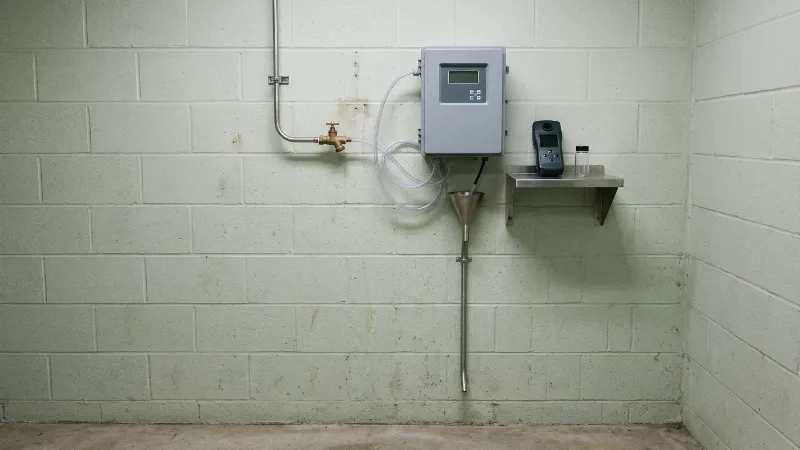
An online chlorine analyzer is the plant’s record of the residual leaving it, and it drifts. EPA Method 334.0 says how to keep it honest with grab samples: how often, how close the two must agree, and what to do when they don’t. Every requirement here is quoted from the method or the federal rules, which we read on November 1, 2026. Your state may ask for more.
The short answer
- At least once a week, compare the analyzer with a grab sample analyzed by an approved method, such as DPD or amperometric titration.
- They agree when the analyzer is within 0.1 mg/L or 15% of the grab sample, whichever is larger.
- After maintenance, compare again when the analyzer is back in service, and again a day later.
- When they don’t agree, look at the analyzer first, then check the grab sample method, and only then adjust the analyzer. Compare again a day later.
- A new analyzer needs 14 days of daily comparisons that all agree before it’s used for compliance.
How far the analyzer may be from the grab sampleThe larger of 0.1 mg/L and 15% of the grab sample
Method 334.0 covers residuals from 0.2 to 4 mg/L, free or total. Where it leaves a choice to the “primacy agency”, that’s your state’s drinking water program.
Why the analyzer has to be right
For a plant that filters surface water, the federal rule reads:
“The residual disinfectant concentration of the water entering the distribution system must be monitored continuously, and the lowest value must be recorded each day, except that if there is a failure in the continuous monitoring equipment, grab sampling every 4 hours may be conducted in lieu of continuous monitoring, but for no more than 5 working days following the failure of the equipment …”40 CFR 141.74(c)(2)
And the residual it records has a floor:
“The residual disinfectant concentration in the water entering the distribution system, measured as specified in § 141.74 (a)(2) and (c)(2), cannot be less than 0.2 mg/l for more than 4 hours.”40 CFR 141.72(b)(2)
So the analyzer’s reading is the compliance record. One that reads high hides a low residual, and one that reads low can show a violation that never happened. The same paragraph lets systems serving 3,300 people or fewer take grab samples one to four times a day instead. The federal rules list Method 334.0 among the approved methods for free and total chlorine, beside DPD and amperometric titration (Appendix A to Subpart C of Part 141).
How close is close enough
“The analyzer concentration must be within ±0.1 mg/L or ±15% (whichever is larger) of the grab sample measurement.”Method 334.0, §11.2
Fifteen percent of the grab sample equals 0.1 mg/L at about 0.67 mg/L. Below that, the analyzer may be 0.1 mg/L either side. Above it, 15%.
| Grab sample, mg/L | Allowed difference | The analyzer may read |
|---|---|---|
| 0.20 | ±0.10 | 0.10 to 0.30 |
| 0.50 | ±0.10 | 0.40 to 0.60 |
| 1.00 | ±0.15 | 0.85 to 1.15 |
| 1.20 | ±0.18 | 1.02 to 1.38 |
| 2.00 | ±0.30 | 1.70 to 2.30 |
| 4.00 | ±0.60 | 3.40 to 4.60 |
Three weekly checks
They agreeThe grab sample reads 0.80 mg/L and the analyzer 0.89. 15% of 0.80 is 0.12, larger than 0.1. The analyzer is 0.09 off, within 0.12.
They don’t agreeThe grab sample reads 1.40 and the analyzer 1.12. 15% of 1.40 is 0.21. The analyzer is 0.28 off.
They don’t agree, though it’s closeThe grab sample reads 0.35 and the analyzer 0.48. 15% of 0.35 is 0.05, so 0.1 is the larger. The analyzer is 0.13 off.
Taking the grab sample
“The grab sample collection point should be as close as possible to the location where the sample enters the on-line chlorine analyzer, so that the grab sample reflects the same water as the on-line analyzer is measuring.”Method 334.0, §7.1
- Handle it gently and quickly. The method says to collect it “with minimal agitation”, out of sunlight or strong light, and: “Begin analysis immediately after sample collection. Do not store samples.” (§7.1)
- Measure the same thing the analyzer measures: free chlorine against free, total against total.
- An approved method. “Amperometric titration or N,N-Diethyl-p-phenylenediamine (DPD) colorimetric methods are the most commonly used approved grab sample methods.” (§5.2)
- A calibrated meter. The grab sample method needs an “acceptable initial calibration” before it can check an analyzer (§9.1), with its lowest standard “at or below 0.2 mg/L or the minimum chlorine residual required by the state” (§10.1.1.1). A check standard is run at least once a quarter, and whenever a grab sample is used to adjust the analyzer (§11.1.1).
When they don’t agree
The method sets an order, and adjusting the analyzer comes last:
- Look at the analyzer. Disagreement “may indicate a need for maintenance on the analyzer (e.g., flow adjustment, pH adjustment, cleaning, new membrane, fresh reagents, etc.)”, and problems must be ruled out “prior to making calibration adjustments.” (§11.2.1)
- Take a second grab sample if you like, to rule out the first one. (§11.2.1.1)
- Check the grab sample method with a calibration check standard. (§11.2.2)
- Adjust the analyzer by the maker’s instructions, “so it gives the same value as the grab sample analysis.” (§11.2.3)
- Compare again a day later. “An additional grab sample must be collected and analyzed after one day of operation in order to verify that the calibration adjustment was performed accurately.” (§11.2.6)
Some comparisons come between the weekly ones:
- After maintenance, such as cleaning, new reagents, a new membrane or a flow adjustment: compare when the analyzer is back in service, and again after a day of operation. (§10.2.5, §11.3.1)
- A slow drift up or down, with nothing in the plant to explain it: take a grab sample. (§11.3.2)
- A sudden change of more than 50% that the plant doesn’t explain: take one “as soon as possible.” (§11.4)
Putting an analyzer into service
“Compare the concentration determined by the on-line chlorine analyzer with grab sample analyses collected at least daily for 14 days. (If samples cannot be collected during the weekend, 14 consecutive business days is acceptable.)”Method 334.0, §10.2.2.3
- Every pair must agree, by the same 0.1 mg/L or 15%. One that doesn’t means finding the problem, fixing it, and carrying on with daily grab samples until there are 14 days in a row that agree.
- Cover the range. The grab samples should catch the highs and the lows the analyzer sees.
- An analyzer that can’t pass may be used for compliance “only if grab sample comparisons are conducted daily or at a frequency approved by the primacy agency.” (§10.2.2.4)
- After a major repair or a replacement, verify it daily for 7 days in a row, or as your state sets. (§11.5)
What to keep
- The analyzer’s own record: its readings “must be continually recorded (hard copy chart or electronic data).” (§5.1.1)
- Every comparison: “All data from these comparisons must be recorded and maintained according to the requirements of the primacy agency.” (§11.2)
- The grab sample meter’s calibrations and check standards. (§10.1.1, §11.1)
The method doesn’t say for how long. Your state does.
Keeping track of it in ShiftRounds
- The checklist. The chlorine analyzer checklist asks for free chlorine, total chlorine, whether sample is flowing, whether the reagent is OK, and a photo and note. No sample flowing, or reagent that isn’t OK, is a yellow finding.
- The weekly comparison. Put it on the round as a reading that’s checked against SCADA: the operator types the grab sample result, then the analyzer’s value as SCADA shows it, and the sign turns yellow when the two are further apart than you allow. Allow 0.1 mg/L. That’s the method’s figure below about 0.67 mg/L, and stricter above it, where the method allows 15%: the check takes one figure, so it can’t say “whichever is larger”.
- Drift shows on Trends, where every reading of the residual is drawn against its expected range.
- Every reading says who took it and when, and each round’s report keeps them.
ShiftRounds doesn’t keep the analyzer’s continuous record or the meter’s calibration log; those stay in SCADA and the lab book. More on rounds for water treatment plants.
Where this comes from
- EPA Method 334.0, Determination of Residual Chlorine in Drinking Water Using an On-line Chlorine Analyzer, Version 1.0, EPA 815-B-09-013, September 2009.
- 40 CFR 141.74(c)(2) and 141.72(b)(2), and Appendix A to Subpart C of Part 141, in the Code of Federal Regulations revised as of July 1, 2025.
Read on November 1, 2026. Quotes are as the text has them.